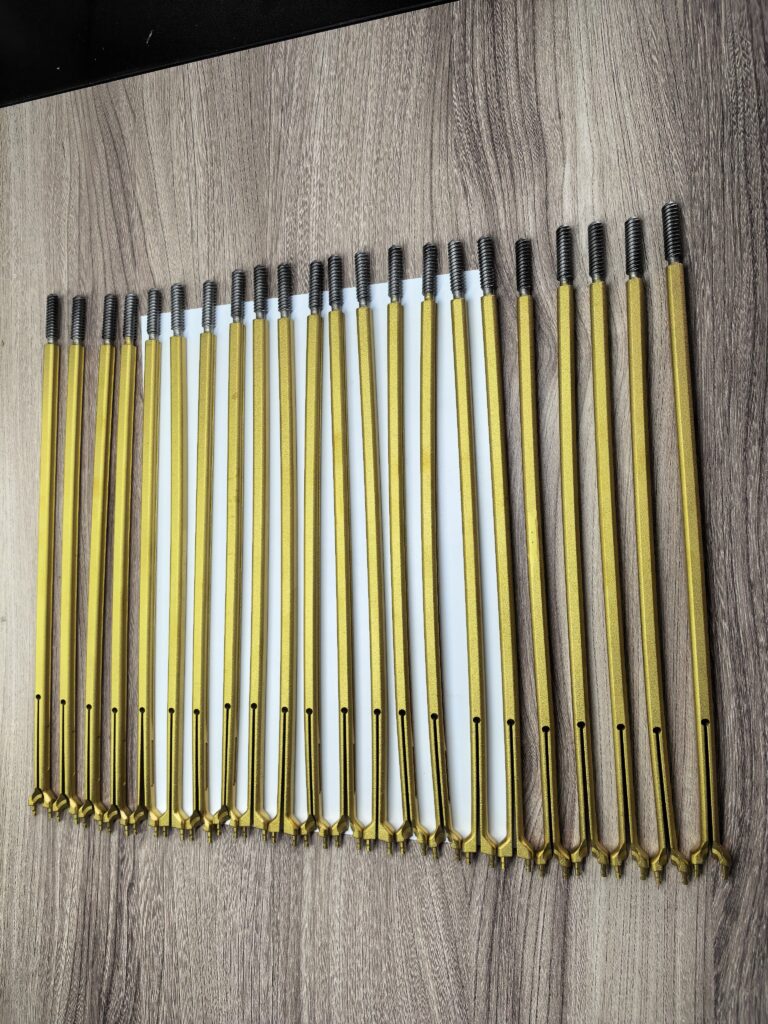
“H950” refers to the precipitation-hardening condition of 17-4 PH stainless steel, aged at 950 °F (510 °C).
For 3D-printed (additively manufactured) 17-4 PH, the heat treatment is similar to wrought material, but there are important AM-specific considerations because of residual stress, anisotropy, and microsegregation.
Below is a practical, industry-standard heat-treat route to achieve H950 from AM 17-4 PH.
1. Starting condition (as-printed)
- AM 17-4 PH is typically:
- Martensitic + retained austenite
- High residual stresses
- Fine cellular microstructure
- Direct aging without solution treatment is NOT recommended for critical parts.
2. Stress relief (recommended for AM parts)
Purpose: Reduce residual stresses and distortion before solution treatment.
Typical cycle:
- Heat to 650–750 °C (1200–1380 °F)
- Hold 1–2 hours
- Air cool
Some AM vendors skip this step if hot isostatic pressing (HIP) is used.
3. Solution annealing (Condition A)
Purpose: Dissolve copper precipitates and homogenize the microstructure.
Cycle:
- Heat to 1040–1065 °C (1900–1950 °F)
- Hold 30–60 minutes
(30 min for thin parts, 60 min for thicker sections) - Rapid cool:
- Air cool (minimum)
- Oil quench or inert gas quench preferred for uniformity
Result:
Material is now in Condition A, soft and ready for aging.
4. Aging to H950 condition
This is the defining step.
Cycle (per AMS 5643 / ASTM A564):
- Heat to 950 °F (510 °C)
- Hold 4 hours
- Air cool
Do NOT slow cool. Air cooling is required.
5. Expected mechanical properties (AM, typical)
After proper solution + H950 aging:
| Property | Typical AM H950 |
|---|---|
| Hardness | ~40–44 HRC |
| UTS | ~1300–1450 MPa |
| Yield strength | ~1100–1200 MPa |
| Elongation | ~6–10% |
AM parts often show slightly lower ductility than wrought unless HIP is used.
6. Optional: HIP (strongly recommended for critical parts)
If maximum fatigue strength and ductility are required:
HIP (before aging):
- ~1150–1200 °C
- 100–150 MPa
- 2–4 hours
- Inert gas atmosphere
Then:
- Solution anneal (if not integrated into HIP)
- Age at 950 °F
7. Common mistakes to avoid
❌ Aging directly from as-printed condition
❌ Skipping solution treatment for load-bearing parts
❌ Slow cooling after aging
❌ Exceeding aging temperature (over-aging reduces strength)
8. Typical full AM heat-treat route (summary)
Best practice sequence:
- Stress relief (optional)
- HIP (optional but recommended)
- Solution anneal @ 1900–1950 °F
- Rapid cool
- Age @ 950 °F for 4 hrs → H950